Be yourself; Everyone else is already taken.
— Oscar Wilde.
This is the first post on my new blog. I’m just getting this new blog going, so stay tuned for more. Subscribe below to get notified when I post new updates.
Be yourself; Everyone else is already taken.
— Oscar Wilde.
This is the first post on my new blog. I’m just getting this new blog going, so stay tuned for more. Subscribe below to get notified when I post new updates.
With the first few months of 2020 behind us, I can confidently say that social media plays a major role in many world events. As the Coronavirus spreads across the world, people are turning to social media to stay in contact with friends and family, as well as receive important news updates. Without social media, I think that the world’s population, as a whole, would have a harder time social distancing and quarantining. Social media makes it seem as though one is not as separated as they might feel. As the year progresses, I believe that social media will continue to be the main source of entertainment, relationship formation, connection, and news.
Currently, social media is functioning in ways that it had never functioned before. Because of Coronavirus, individuals cannot gather together, making it difficult to attend birthdays or other important life events. Through the power of social media, people have managed to attend many of these life events virtually. This can be seen through watching live streams on Instagram or Facebook. Another way social media has allowed this type of connection is through individuals posting links to Zoom meetings. Through these Zoom meetings, large groups of people can meet and collaborate while at home. Throughout quarantine, I have attended quite a few birthday Zoom parties. Additionally, many funerals have been held over Zoom, which allows individuals to find closure when attending a funeral in person is impossible. According to UCL Press’s book, How the World Changed Social Media: The Future, social media has lead towards the movement of ubiquity [1]. The ability for individuals to still virtually “be” in places during the current pandemic illustrates how social media has enables the idea of appearing everywhere.
Along with connecting individuals, social media has become an important mode of communication for news outlets. Many news companies are turning to social media to constantly update the public on the Coronavirus update, as well as on any important breaking news. Having social media has created a public that is more knowledgeable of current events, and provides a sense of comfort as individuals know that they will be able to receive important updates anywhere. A downside to news outlets turning to social media is the rise in fake news and fake news accounts. In the article, The Future of Social Media: 32 Experts Share Their 2018 Predictions, Brandon Chopp, Digital Marketing Strategists for iHeartRaves and INTO THE AM, predicts this issue of fake accounts. “As more and more users buy likes and followers, it will become more challenging to figure out which accounts are legitimate and which ones are not,” he predicts [2]. His predictions ring true today, as fake news continues to create a more hostile political environment and put individuals in danger through creating false issues. I believe that as we continue to rely on social media, fake news will become a greater threat.
In the future, I believe that the role of social media will continue to be as prominent, if not more prominent, as it is today. Social media is already so integrated into our lives that I do not believe that there will be a decrease in the amount of usage of social media. Although there are many arguments that support elimination of social media, I think that the positives associated with these platforms outweigh the negatives. These revolutionary platforms expose individuals to information at a greater rate than ever before, and enable relationships to form and flourish. I think the ability to stay in contact with those both far away and close by decrease the feeling of loneliness, as there are a large amount of people available for individuals to talk to. I am curious to see what new platforms of social media will be created in the future.
As my last blog post comes to an end, I would like to thank all of my readers for following my social media journey this semester. I enjoyed being able to reflect on the different aspects of social media and find relations to my personal life. I hope that I encouraged you to look at social media through a different lens, and inspired you to discover how you use social media. Thank you again for reading!
-Allie
Notes
As the world becomes more digital by the second, it has become increasingly easier to gather information on the population through big data. With such a vast amount of information comes great responsibility. Through the data collected, businesses and individuals have began to manipulate others by understanding how groups think and act. To fully understand the effects of big data, as seen through the documentary, The Great Hack, it is important to truly understand what big data encompasses.

According to Rebecca Lemov, in her essay ‘Big data is people!’, big data is “a catchall label that describes the new way of understanding the world through the analysis of vast amounts of data” [1]. This data is made of and out of personal data, and is collected through one’s actions on the Internet. The continuous generation of content from the Internet makes this type of data collection different, which explains why it is so impactful. Most of the time, individuals do not realize that their actions or information is being collected, limiting their ability to monitor or control how others view them. Big data comes from a wide variety of sources, such as one’s retail purchases, digital devices that save one’s communication history, online transactions, clickstream data that records navigation through a website or app, scanning machine-readable objects such as travel passes or barcodes, and social media postings [1]. Because technology is so integrated in our daily lives, it is difficult to escape this meticulous data collection. Once this data is collected, companies use AI and machine learning algorithms extract patterns from the information. According to Matt Turk’s article, Is Big Data Still a Thing? (The 2016 Big Data Landscape), these AI or machine learning algorithms can tell a business which customers are more likely to buy or renew a product, which can help creates a successful business model [2]. These predictive algorithms give businesses an advantage over their competitors as they contain valuable knowledge about their consumers, allowing them to target their market more accurately. Though many companies claim that big data is for the consumer’s own good, The Great Hack illustrates the negative outcomes this large collection of data brings.

The Great Hack is a documentary that depicts the Facebook-Cambridge Analytica scandal that influenced the 2016 Presidential Election. The story focuses on Brittany Kaiser, who was the business development director of SCL Group, which was the parent company of Cambridge Analytica. The SLC Group was a private research and strategic communications company that focused on studying and influencing mass behavior. Cambridge Analytica, formed as a subset of the SLC Group, was a political consulting firm that focused on various U.S. elections. The company used information collected from Facebook users’ accounts to create targeted advertisements, with the ultimate goal to persuade Americans to vote for Donald Trump. By creating an online survey, Cambridge Analytica gained access to millions of Facebook user’s private information, and the information of their Facebook friends. As a result, according to former Cambridge Analytica CEO Alexander Nix, the company possessed 5,000 data points on every American voter.

Reflecting on the information I learned from The Great Hack, I think think that the positives associated with big data outweigh the negative aspects. A result of big data is personalization, which is a luxury that a majority of individuals enjoy. Personalization is used on various online platforms, such as Netflix, online shopping websites, and iBooks. Companies use one’s previous actions on different websites to create suggestions specific to an individual, which exposes them to appealing products or services they might not have seen otherwise. It makes it easier for one to find television shows, movies, books, clothing items, cleaning supplies, and other products that they like. Without this information collected through Big Data services, the accessibility we get with personalization will be gone. I believe to combat issues of manipulation, I think that there should be more regulations on what information can be collected on individuals and how this information can be used. Along with these regulations, companies should be more transparent with their data collection practices, and specify exactly what information they are taking from their users. As the various uses for big data grows, I hope that companies choose to use the mass amounts of information for good rather than for evil.
Notes
Kylie Jenner: A Young Billionaire
An influencer that currently interests me is Kylie Jenner. Kylie is a 22 year-old who is the founder and owner of the cosmetic company, Kylie Cosmetics. Kylie currently has a net worth of US $1 billion. She is a part of the Kardashian-Jenner family, and gained her fame through starring in the reality television series, Keeping Up with the Kardashians. With her family’s connections, she was exposed to the entertainment industry at a young age, which helped her gain the resources necessary to create cosmetic company. Kylie has become an influencer through her large Instagram and Snapchat following, which she uses to market her personal products from Kylie Cosmetics as well as showcase her personal life.

Though Kylie’s status as a celebrity was achieved through her family’s fame, she created her personal brand on her own. According to Ann Friedman in her article, Me, Inc., the three principles of a good personal brand are authenticity, differentiation, and relevance [1]. It is apparent that Kylie uses these three principles when analyzing her Instagram page. The authenticity of her personal brand is illustrated through the types of pictures she posts. The pictures appear to be taken on her personal phone, including mirror selfies and pictures of her daughter. Posting pictures from her personal phone, instead of pictures taken by professionals, shows her followers that she creates her own content and posts what she believes they will like. Kylie ensures that her posts are differentiated through posting pictures of her makeup products, her daughter, her family, and her friends. Maintaining variation of pictures ensures that followers will be interested and entertained by the content, as there is always something different to see in a new post. Finally, Kylie achieves relevance through the types of pictures she posts. A majority of her Instagram page is made up of pictures of Kylie with her family, with her daughter, or with her friends. Though Kylie is anything but ordinary, 22 year-olds, as well as individuals from all ages, can identify with her pictures as they illustrate important values of family and friendship. This relevance to the younger generation works to maintain her large following.


Kylie also uses her status as an influencer to sell her products from Kylie Cosmetics. When analyzing the company’s business plan, one can see that the founder does not spend a single US dollar on advertisement. Instead, Kylie uses her Instagram and Snapchat accounts to promote and sell her makeup products. Followers are informed of new products or promotions through posts Kylie makes to her Instagram and Snapchat stories. These stories only last twenty-four hours, so followers must be dedicated in order to see important information about the company. This method saves Kylie money, and allows put more resources towards creating new makeup products. Marisa Meltzer, in her article on Busy Philipps in The New Yorker, discusses how celebrities use social media to increase the success of their careers. In addition, she argues that early adopters of social media platforms define its potential [2]. Through Kylie using Instagram to promote and sell her products, she influenced the social media platform to create a feature that allows for direct purchase on the app. This feature makes it easier for any follower to purchase a product seen in an Instagram post, thus increasing the amount of sales Kylie is able to make.


Notes
Check out my video to see my portion of the debate on Social Credit Systems.
“If social credit systems are an upcoming reality in some countries, which is the role that social media would play in our future societies?”
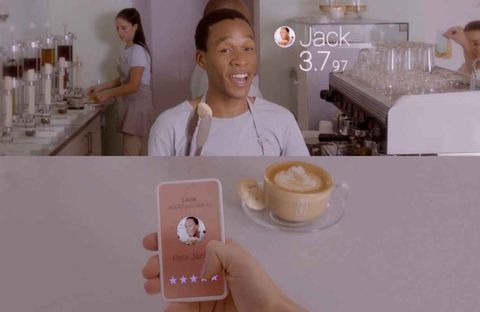
The Black Mirror episode, Nosedive, depicts a society in which a person contains a number rating out of five, and this rating determines what this person can or cannot do. The episode follows Lacie Pound, a young woman who works to achieve a high rating in society. She wants to elevate her status so that she can move into a more luxurious residence home and have high-class friends. In the beginning of the episode, she has a rating of 4.2, meaning that she is ranked middle tier. The beginning scenes show her practicing her laugh in front of the mirror and perfecting her smile. It is obvious that she is worried about what other think of her and wants to grow her status. Lacie lives with her brother who has a lower rating than her. Lacie wants to look for a new home, and decides on a new luxury living community. In order to afford this new home, she needs to boost up her rating to a 4.5, which is a difficult process. The opportunity to raise her score presents itself when she is chosen to be the maid of honor for her popular childhood friend, Naomi.
The episode follows her journey to get to Naomi’s wedding, in which there are a series of obstacles. These obstacles lead to her score decreasing all the way to a 2.8. With her low rating, she was unable to receive perks such as getting a new flight after her old one was cancelled and getting a better operating rental car. People began to ignore and treat Lacie badly due to her low score. In the end of the episode, Naomi disinvites Lacie to her wedding due to her low score. Lacie shows up anyways, and ruins the wedding by speaking badly about Naomi. At the end, Lacie is thrown in jail, and is looked down upon because of her low score.
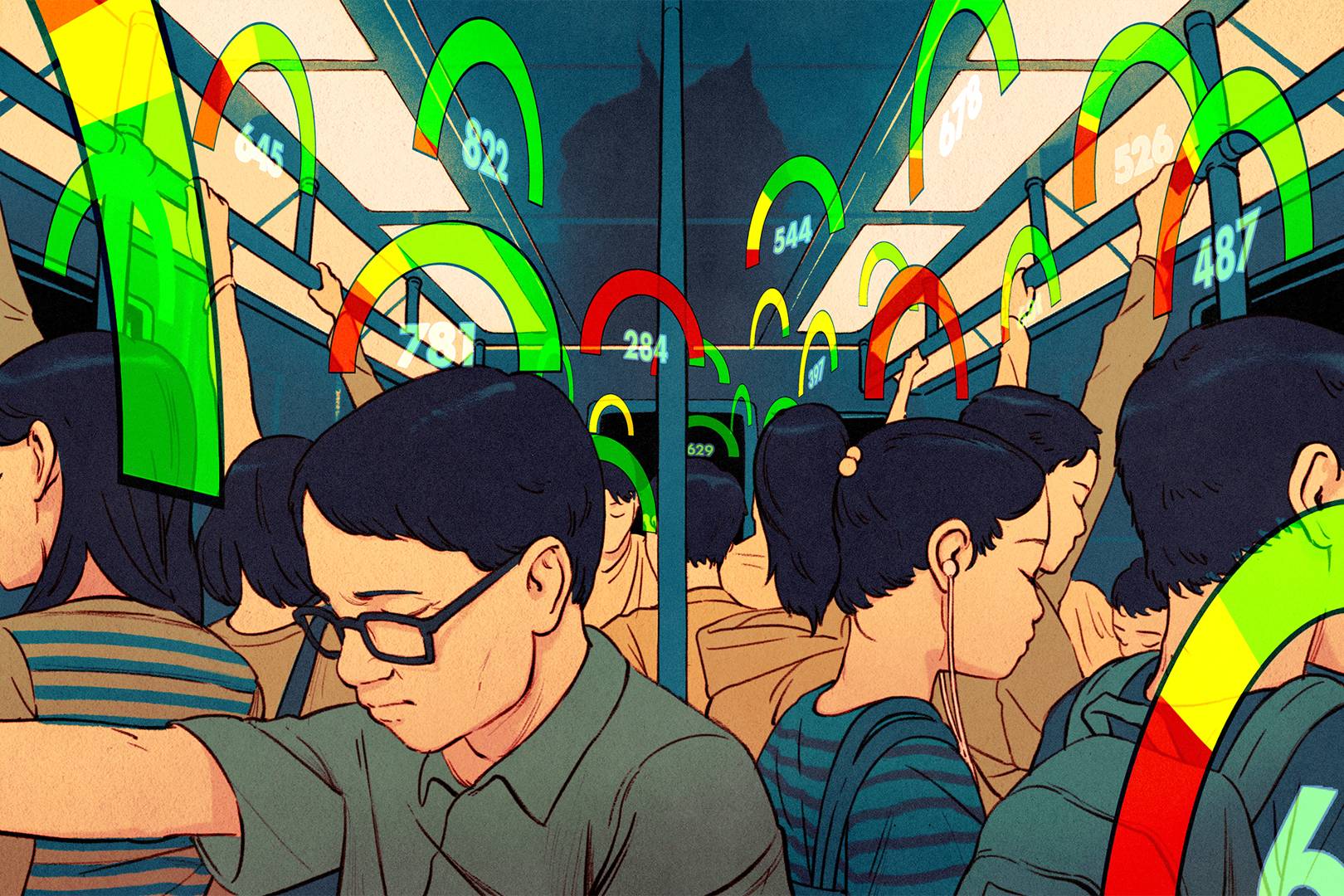
Nosedive relates to the events that are taking place in China. According to the Wired Article by Rachel Botsman, China is moving towards creating a rating system similar to the one in the Black Mirror episode. This system, called a Social Credit System, is used to rate the type of citizen one is [1]. It uses big data to get personal information about any of its 1.3 billion residents. The information they collect consists of online interactions collected by big data companies like Google, Facebook, and Instagram, as well as health information from apps like Fitbit. The information is then aggregated together to create a single number, also known as a Citizen Score, that will tell the public whether or not an individual is trustworthy [1]. One’s rating will be publicly ranked against the entire population, and can determine how qualified one is to apply for a mortgage, a job, or a school. According to the Chinese government, this system is useful because it is a “desirable way to measure and enhance ‘trust’ nationwide and to build a culture of ‘sincerity”’ [1].
One might argue, on the other hand, that this type of culture promotes insincerity rather than sincerity. Just as in Nosedive, when Lacie practices her fake laugh and smile, residents in China will also be regulating their behavior in order to receive a high rating. This is limiting because it doesn’t give the Chinese the freedom to be themselves. Having this type of society will make residents feel trapped, as they do not have the ability to do what they like. They will constantly have to worry about what they say in public and what they say online. It is unfair that people’s lives are determined by a made-up number, and that this number has such a large effect on what they are able to achieve. Overall, this type of system makes for a more divided society. Alternatively, there have been some success associated with this type of system. In a New York Times article by Paul Mozur, police in China have been able to catch criminals or those who are breaking laws using artificial technology. According to the article, China has been using “billboard-size displays [that] show the faces of jaywalkers and list the names of people who don’t pay their debts” [2]. Through this type of surveillance, the government is able to more closely regulate its citizens and encourage that they follow laws or pay their debt. The embarrassment of one’s name being projected on a screen is supposed to encourage civilians to follow the rules of the society and to not disobey the government. Using this type of technology takes some pressure of the police, as the abundance of surveillance footage is able to see larger portions of society that a normal human may miss.
In this type of society, social media will play a massive role as it will be the main source of data that the government collects. Since the government has access to one’s friends and family on social media, they will be able to see any posts that negatively reflects oneself, which can change their overall rating. One can also be associated who they follow or are friends with on social media, which might give them a bad rating. One’s actions has the power to determine the fate of those who they are most closely connected with. As these types of societies progress, I think that the usage of social media accounts will decrease because citizens won’t enjoy being consistently monitored. With this decrease, the importance of social media accounts to rate citizens will be eliminated, and the government will have to look for other means of data about their citizens.
Notes
A reflection of my own social media use
According to Jerry Saltz, in the article, Art at Arm’s Length: A History of the Selfie, a selfie is an instant visual communication of where we are, what we’re doing, who we think we are, and who we think is watching [1]. One uses this type of image to illustrate to others who they are. As discussed in class, selfies are not meant to remain in a private album, but they are made to be shown, shared, and seen by others. Throughout my time on social media, the way in which I take and post selfies has changed due to the ever-changing nature of the various platforms.
When I first created my Instagram, my selfies were more posed and unnatural. I also was not sure how to pose myself since social media was so new. In the beginning of Instagram, I mostly posted pictures with others because I self-conscious about the way I looked. To compensate for my self-consciousness, I decided to post pictures of myself with other objects so that the attention wasn’t fully on me.


This image on the left, which I posted on Instagram and made my Facebook profile picture, includes a tree and fall leaves in the background. I am touching the tree in order to draw my followers’ eyes to the object so that I wasn’t the only focus in the picture. I am carefully posed with my hand on my hip, making the picture seem forced and unnatural. Looking back on this image eight years later, I wish that I had posted a selfie that was more natural and fun. I continued to pose with my hand on my hip in other old selfies, which can be seen on the right. In this selfie, you can tell that I am trying hard to look good because my smile is very wide and it looks like my eyebrows are really raised. In this era of social media, it was normal for individuals to pose this way in order to get the most amount of likes and comments. I also used a black and white filter to make the picture more dramatic, which is a filter I don’t use anymore. In Saltz’s article, he argues that selfies are “usually causal, improvised, [and] fast” [1]. The way I took my old selfies contradict this argument because I would spend a long amount of time getting ready for my picture to be taken, putting on makeup and carefully choosing my outfit. I would spend hours taking the actual picture, as well, so that I would have the perfect selfie to post.
As I have gotten older, and the ways in which one uses social media has changed, I believe that my selfies have gotten more mature. I now want to post selfies that depict my personality, and make me seem more relatable. This includes posting selfies at school on game days or in new countries that I have traveled to abroad. I still continue to try to have other objects in the images so that all of the focus is not on myself, but I feel like I have gotten more confident in my selfies based on my poses. I decide to post selfies in moments where I am truly happy, or when I am somewhere exciting that I want others to see. When taking selfies now, I think less about my pose and more about my background and the story that my image illustrates. This can be seen in my picture from game day, my selfie in the Sketch bathroom in London, and my selfie on a Jeep in Israel.


After reading Mary Pilon’s article, Instagram Is Ruining Vacation, I began to reflect on my social media use abroad. Pilon argues that Instagram defines our visual moment, and uses Susan Sontag’s claims that photographs are used as “indisputable evidence” to prove a trip was “fun” [2]. In my own experience abroad, I have felt the need to take pictures, not to prove that my travels are fun, but to remember the amazing moments I am experiencing. Whenever I go to a famous tourist spot, a pretty view, or a cool building, I want to take picture so that I have memories to look back on. Contrary to Pilon’s argument, I decide to post pictures on Instagram from my travels to show my followers, which consists of mostly my friends and family, the cool activities that I am doing, rather than to prove that I am having fun abroad. I feel like others may post for this reason, but I think Pilon making this assumption of all Instagram users is unfair. I think that it is okay to take pictures of basic activities abroad, such as a sunset that you are looking at, because it is an experience that you are going to want to remember forever. I don’t think that people should be shamed for the way in which they choose to remember their travels.
Notes
Check out my videoblog on my use of social media abroad down below!
The Monetization of The Mannequin Challenge
McDowell perspective: Memes as an expression of monetization of user-generated content
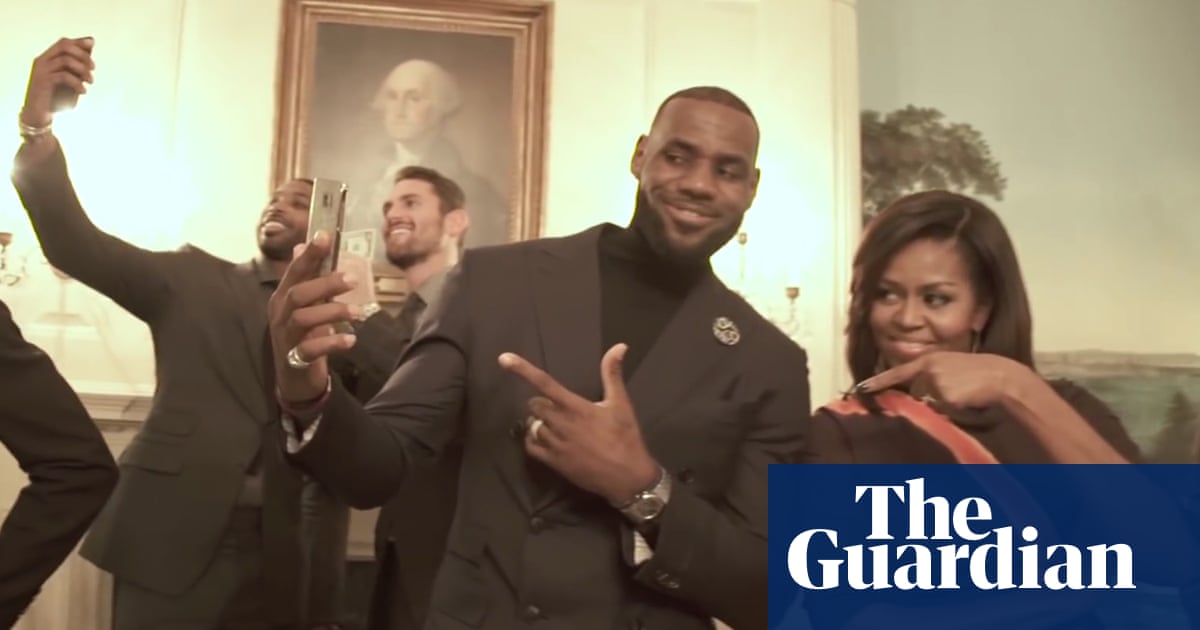
The Mannequin Challenge was a viral video trend that swept the Internet in November 2016. The video consists of people standing still, like mannequins, while a moving camera films them. In each video, the song “Black Beatles” by Rae Sremmurd plays in the background. McDowell’s 2014 article, Monetizing a Meme: A Case Study on The Harlem Shake, argues that a meme is an expression of monetization of user generated content. One can use McDowell’s argument to explain how a similar meme, The Mannequin Challenge, became a viral meme and explore the relationship between ownership, authorship, and digital sharecropping.
McDowell’s article illustrates The Harlem Shake’s roadmap to success, beginning with the creation of the song. The Harlem Shake was a compilation of various songs created by American DJ, Baauer. He originally released the track as a free download under the label, “Mad Decent”. Instantly, it was awarded as “Best New Track”, and Baauer was praised by the New York Times as a “rising talent”[1]. The song gained popularity eight months later, when a group of YouTubers released a video dancing in tight costumes to The Harlem Shake. The Harlem Shake became a viral meme as various others uploaded videos replicating the original dance. During this craze, Baauer was able to monetize his song through YouTube’s copyright profit-sharing system, Content ID[1]. Though this service, Baauer was able to claim ownership of The Harlem Shake song and receive profits based on viewership from all videos containing his song. This is an example of digital sharecropping, as video creators were able to use The Harlem Shake song for free, but had to give up a portion of the profits as a result.
Similarly, this is exemplified through Rae Sremmurd’s song, Black Beatles, used in The Mannequin Challenge. Those who participated in the challenge were able to use the song for free and post the video on any social media platform. With the help of Content ID, Sremmurd profited off of every Mannequin Challenge posted through the amount of views each video received. The use of Content ID showcases how digital sharecropping is the main economic system on the Social Web. Many content creators are able to use other’s songs, ideas, and artwork for free, with the only trade-off being that the original creator receives a portion of the new creator’s creation. So long are the days that one needs a license or right to use another’s idea, as the mutual agreement of sharing profits is enough to create a trustworthy economic system. In addition, the popularity of the challenge itself increased the amount of money Sremmurd made off the song. Paid downloads of the track shot up after the challenge gained traction, reaching 144,000 downloads in the November 2016 chart period, compared to just 22,000 downloads two weeks prior[2]. The Mannequin Challenge provided Sremmurd with free publicity of his song that resulted in more profits than imagined.
To understand why The Mannequin Challenge went viral, one can use Richard Dawkins’ three characteristics every meme requires to become a viral phenomenon: replicability, fecundity, and longevity. Replicability is the ability of the meme to “hook” or inspire others to contribute their own version of a meme. This was seen through countless videos copying the original Mannequin Challenge created by high school students in Jacksonville, Florida. Replication is the driving force that turned this challenge into a viral meme because it created popularity and inspired other content creators. Fecundity is the ability of the meme to be transmitted and transformed, which usually implies modifying the original meme. Based on this characteristic, The Mannequin Challenge can be characterized as a meme through the various versions creators made. These modifications ranged from new “mannequin poses” to crazy amounts of people participating one video. Finally, according to Dawkins, longevity is the perdurability of the meme in memory. In other words, it is how long the meme remains popular. With the popularity of the Internet, memes are able to last longer than ever before because one can always re-watch a video, and it is more difficult to completely erase content. The Mannequin Challenge can be characterized as a meme because new videos were continuously posted for over a month.
In addition to the three main characteristics, a meme must have humor and intertextuality. The Mannequin Challenge encompasses humor through the various poses participants do throughout the video. The main goal of The Mannequin Challenge was to be frozen in the most ridiculous actions, as this would gain the most viewership. Along with humor, The Mannequin Challenge contains intertextuality because it contains cross-references to a variety of popular culture events and practices through remixing practices. Intertextuality is particularly exemplified through frozen poses that depict popular movie scenes or scenes from important historical events. The number of remixes created for The Mannequin Challenge are far too many to count, which validates the claim that the challenge is a meme.
In conclusion, The Mannequin Challenge showcases the nature of a meme as an expression of monetization of user-generated content, which can be seen by analyzing the trend through McDowell’s perspective. The ability for Sremmurd to profit from the use of “Black Beatles” indicates that digital sharecropping is the main economic system of the Internet, as this mutual agreement enabled both parties to benefit. As memes continue to circulate the Internet, this type of economic system will remain relevant, as it is the most efficient way to ensure all content creators receive the credit they deserve.
Notes
Create Your Own Meme:

Social Media Timeline
2007-2009
Desktop Computer

Youtube

Gmail Account

iPod Touch

2010-2011
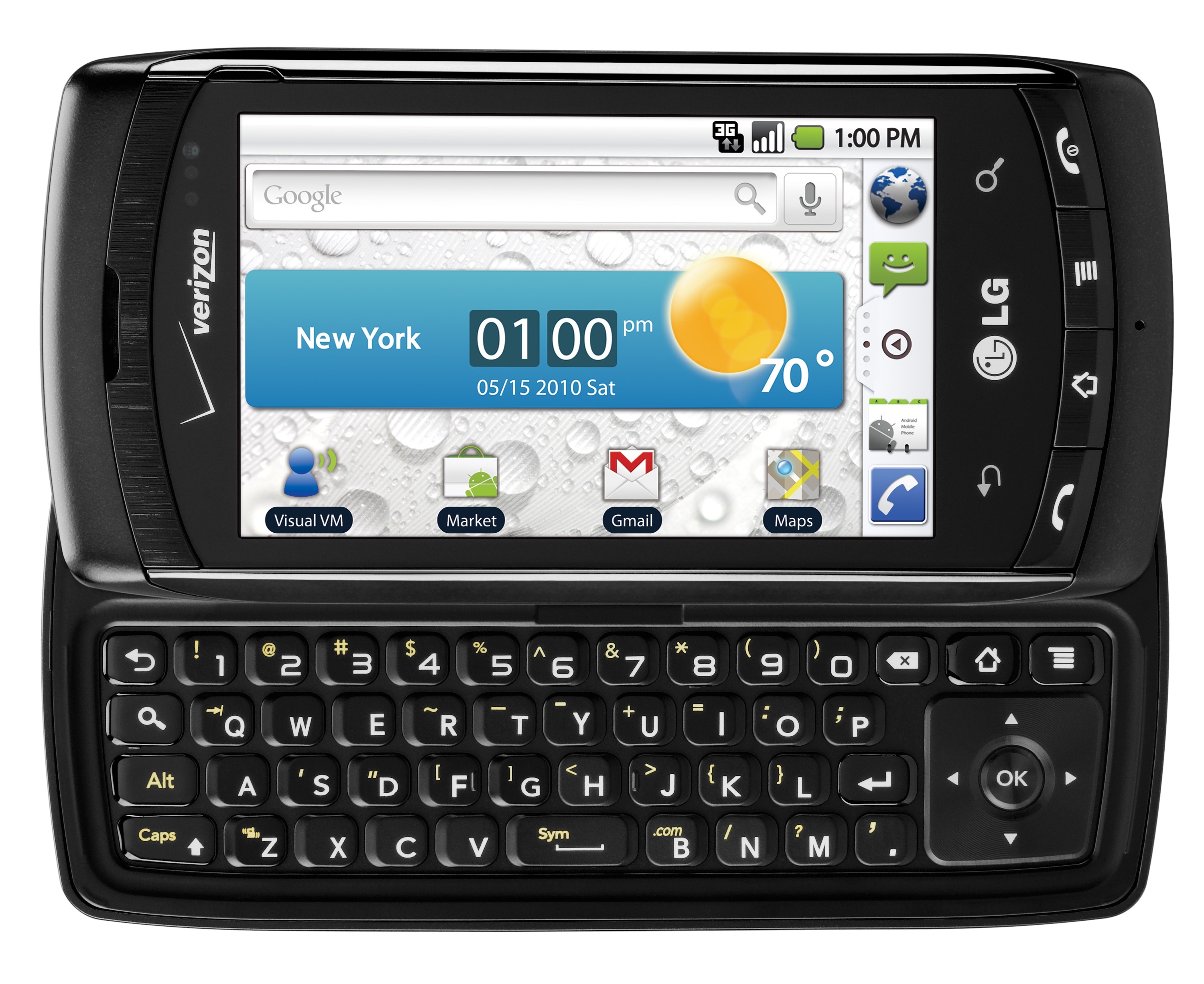
First Phone- LG Ally
iPad
Kik

2012-2014

Snapchat
iPhone 4s (First iPhone)
2016
Spotify

2019
Tik Tok
Reflection
Currently, I have three devices- my iPhone, my iPad, and my Macbook Pro, however, I only use my iPhone and Macbook. I don’t use my iPad anymore because I am able to do the same activities on my iPhone and Macbook, and I have easier access to these activities on those two devices. I always have my Macbook with my because I also use it for my schoolwork. I currently have over 10 online profiles, ranging from Instagram and Facebook to Netflix. I spend about four hours per day online.
In the future, I hope to spend less time online, as I feel like I am wasting my time in a virtual world instead of enjoying the physical world. I want to focus more on my in-person relationships, and continue to explore new places without staying in the comfort of my own home. I hope that the amount of privacy we have online increases, as the amount of data companies have collected about me makes me very uncomfortable. I also hope that we are able to use online platforms for more good in the world, such as spreading information about how to help the environment.
Have a WordPress.com account? Log in now.

